Funeral Flower Etiquette: The Rules Nobody Tells You
Funeral flower etiquette: From twenty years behind a flower-shop counter.
Funeral flowers are governed by an unwritten ruleset that everybody seems to know parts of, nobody seems to know all of, and most florists do not bother explaining because they are busy filling the orders. The rules are not arbitrary. They map to the sequence of a funeral or memorial service, the physical layout of the room, and the specific role a sender has in relationship to the deceased.
I worked these arrangements for fifteen years, mostly in suburban Chicago, mostly for Catholic and Protestant services with regular work for Jewish and non-religious memorials too. What follows is the part I would tell a customer who walked in saying "I have to send flowers for a funeral and I have no idea what I am supposed to do."
This is the practical version, separate from the broader sympathy etiquette piece. Sympathy flowers go to the bereaved at home and through their grief. Funeral flowers go to the service itself. The two have different rules.
The room: what funeral arrangements actually do
A traditional Christian funeral or memorial service uses flowers in three distinct positions. Knowing the positions helps you understand what you are actually buying.
Casket spray. A large floral arrangement that lies across the closed casket lid (or the upper portion of an open casket). This is reserved for the immediate family of the deceased, almost always the spouse, parents, or children. If you are not in this group, you should not be ordering a casket spray. Cost range: $300-$700, often higher for elaborate work.
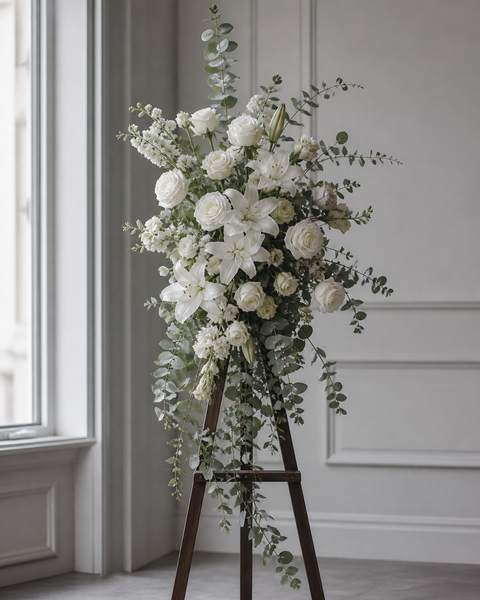
Standing sprays. Tall arrangements on metal easels, positioned around the casket, beside the altar, or framing the entrance to the chapel. These are larger, more formal, often dramatic. Sent by family members one ring out (siblings, in-laws, adult children), close family friends, employers, or organizations to which the deceased belonged. Cost range: $150-$400.
Wreaths. Circular arrangements, typically on standing easels behind or beside the casket. Symbolize eternity. Often sent by extended family, organizations (church, lodge, employer), or close friends. Cost range: $125-$300.
Cross arrangements. Cross-shaped or pillow-shaped, used in Christian services. Sent by religious community members, close friends, or organizations. Cost range: $125-$300.
Vase arrangements. Smaller, less formal, suitable for the side tables and reception area. Sent by friends, coworkers, neighbors. Cost range: $60-$150.
Floor baskets. Mid-size arrangements in baskets that sit on the floor at the entrance or around the casket. A practical choice for senders who want presence without the cost of a standing spray. Cost range: $80-$180.
Plants. A green or flowering plant in a basket, often peace lily or chrysanthemum. The "lasts longer than the service" gift, which the family takes home afterward. Cost range: $40-$120.
The rule of thumb: more formal positions (casket spray, standing spray, cross) are reserved for closer relationships. Smaller arrangements (vase, basket, plant) are for further-out relationships.
What to send by your relationship to the deceased
This is the matrix that gets people stuck. Here is how to think about it.
Immediate family (spouse, parent, child of the deceased)
Casket spray. Or a major standing spray if the casket spray is being handled by another immediate family member. Always white and cream tones with green accents. Roses, lilies, hydrangeas, eucalyptus.
Coordinate with the funeral home in advance to confirm placement. The funeral director will tell you what is already coming and what slots remain.
Sibling, in-law, or adult child of the deceased (when not the primary family arrangement)
Standing spray on an easel, positioned at a flanking spot near the casket. Wreath if a wreath has not yet been ordered. Mid-formal palette: white with cream, soft pink, blush, or pale yellow accents.
Niece, nephew, cousin
Smaller standing arrangement, basket arrangement, or wreath. Mid-size, mid-cost ($100-$200).
Close friend of the deceased
A wreath, a basket, or a plant. The plant is often the right call here because the family takes it home afterward and remembers who sent it. Cost $80-$150.
Coworker or neighbor
A vase arrangement or a basket. Sent in the name of "the coworkers at [company]" or "your neighbors on [street]" if it is a group effort. Cost $60-$120.
Acquaintance, distant connection, or someone sending out of obligation
A small vase arrangement or a sympathy plant. The gesture is more important than the size of the arrangement. Cost $50-$80.
Organizations the deceased belonged to (church, club, employer)
Wreath or standing arrangement, typically with a ribbon naming the organization. Cost $150-$300.
The white-and-green default
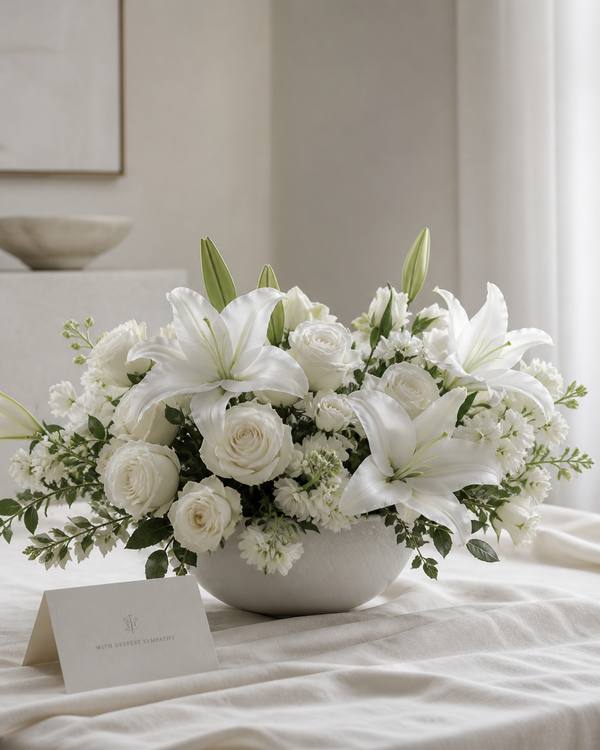
For Western Christian and most non-religious funerals, the visual default is white flowers with green foliage. White roses, lilies, hydrangeas, mums, with eucalyptus or salal greenery. This is the safest palette and the one funeral directors expect.
A note on which lily. "Lily" is a loose word and the wrong one will arrive looking wrong. The funeral lily is from the Lilium genus: Stargazer, Casablanca, Easter, or Oriental lily. Long-stemmed, large white blooms, strong fragrance, each bloom lasting four to seven days. Day lilies (Hemerocallis) are a different genus, usually orange or yellow, each bloom lasting only a single day. They are garden flowers, not florist flowers, and not appropriate for funeral work. Calla lilies (Zantedeschia) are not technically true lilies but are common and appropriate. White calla in particular carries a strong dual meaning in Italian Catholic tradition: the same flower is the classic Italian bride's bouquet and a regular fixture at Italian funerals. The shared symbol is purity and passage. Purple calla is the specifically mourning-coded variant. Peace lilies (Spathiphyllum) are the potted-plant version and the right call when sending a "plant" to the family. When you ask for "white lilies" at a florist, specify Stargazer, Casablanca, or Oriental.
Soft accents (cream, blush, pale yellow) are acceptable for less formal services or when the family has indicated a celebratory or "celebration of life" theme. Bright reds, hot pinks, yellows, and oranges are not appropriate for traditional funerals unless the family has explicitly requested them.
A growing trend is "favorite flowers" or "favorite colors of the deceased" arrangements, particularly for celebration-of-life services rather than traditional funerals. If the family has communicated this, follow the lead. If they have not, default to white-and-green.
When to use colors other than white
White-and-green is the safest default, but it is not the only acceptable palette. Specific colors carry specific meanings, and some are expected for particular traditions, ages, and relationships. The wrong color is not a disaster. The right color signals attention.
Purple
Purple is the second-most-common funeral color after white-and-green, and the one most likely to be appropriate when white feels too plain. It carries weight in two distinct traditions.
Liturgical purple. In Catholic and Eastern Orthodox practice, purple is the color of penitence and mourning. It is the color the priest wears during Lent and at funerals. A Catholic funeral arrangement with purple iris, lisianthus, or stock paired with white lilies and roses reads as visually right to anyone in the tradition. It is also a respectful choice for funerals of clergy or deeply religious families even when the tradition is not your own.

Purple iris in a clear vase. The Catholic and Orthodox tradition reads this as the right color for mourning.
Royal-purple mourning. Outside the liturgical context, deep purple has a centuries-old association with mourning in Western Europe, particularly for older women, matriarchs, and dignified figures. A standing spray with deep purple roses, dahlias, or lisianthus reads as honor and respect. Lavender carries a related but softer meaning: remembrance, often used at memorial services months or years after the death.
When in doubt about whether purple works: ask the funeral home what the family has already ordered. If purple is in the room, follow the lead. If everything is white-and-green, do not be the first to introduce a different color.
Pink and blush
Soft pink, blush, and pale peach are the gentlest deviation from white. Appropriate for the funeral of a younger person, a child, a mother of young children, or anyone whose family has indicated a softer or less formal tone. A spray of white roses with pink peony or blush garden roses reads as tender. Avoid hot pink. It crosses into celebration territory.
Yellow and soft gold
Pale yellow signals friendship and warmth. A traditional choice from longtime friends of the deceased, particularly for older men where yellow roses carried a specific meaning ("friendship" in the Victorian language of flowers). Bright marigold or lemon yellow is too celebratory. Cream and pale-butter yellow are appropriate.
Red
Red is the most contentious sympathy color. Within the immediate family, deep red roses are appropriate from a spouse, signaling romantic love. From anyone outside the immediate family, red roses are unusual at a traditional funeral and should be avoided unless the family has explicitly chosen a red palette. Red carnations have a different reading. They are common in some Eastern European and Greek Orthodox practices and acceptable in those contexts.
Bright multicolor (celebration of life)
If the family has used the words "celebration of life" rather than "funeral" or "memorial service", brighter and more varied palettes are appropriate. The deceased's favorite colors, garden flowers, sunflowers, mixed wildflowers all work. Follow the lead of the announcement and the family's communication. If the family has not said "celebration", do not assume it.
Color avoid list by tradition
- Buddhist services: avoid red. It is associated with celebration and weddings, not mourning.
- Hindu services: white-only arrangements are not always positive in some regional traditions; yellow and red can be appropriate. Ask the family.
- Catholic services: avoid bright orange or fluorescent colors; muted tones only. Purple is welcome.
- Jewish services: the question is moot in most cases. Flowers themselves are not customary.
Religious traditions worth knowing
The defaults above apply to Western Christian and non-religious services. Other traditions have different conventions.
Jewish funerals. Flowers are not customary at Jewish funerals or shivas, particularly in Orthodox and Conservative practice. The expected gesture is food sent to the family during shiva, or a charitable donation in the deceased's name. Sending flowers to a Jewish funeral is not offensive, but it is unusual and sometimes returned. When in doubt, ask a mutual friend or send food and a donation instead.
Muslim funerals. Flowers at Muslim funerals vary by tradition and family. Simple white arrangements are acceptable in many practices. Lavish or showy arrangements are usually discouraged. When in doubt, send the arrangement to the family's home rather than to the funeral or burial site, and keep it simple.
Buddhist funerals. White flowers are appropriate. Avoid red flowers (associated with celebration in many Buddhist traditions). Do not bring food (often discouraged at Buddhist services).
Hindu funerals. Practices vary widely by region and family. White or yellow flowers are generally appropriate. The family will often have specific guidance; ask if you are not sure.
Catholic funerals. Standard white-and-green tradition. Cross arrangements and rosary motifs are appropriate. Mass cards (a card noting that a Mass will be said for the deceased) are also a meaningful gesture, often paired with flowers or sent instead of them.
Mormon (LDS) funerals. Flowers are appropriate. Avoid arrangements with crosses (uncommon in LDS practice).
Greek Orthodox or Eastern Orthodox. White flowers, often with floral wreaths or large standing arrangements, are appropriate. Lily-of-the-valley, white roses, white carnations.
When in doubt for any tradition: ask a mutual friend, ask the funeral home, or send a simple white arrangement to the family's home a day or two before the service rather than to the funeral itself.
The ribbon
Most funeral arrangements include a ribbon with a printed message. The ribbon is read by mourners and remembered. Get the ribbon right.
Standard ribbon language by relationship:
- From a spouse: "Beloved Husband" or "Beloved Wife"
- From children: "Beloved Father" or "Beloved Mother"
- From parents: "Beloved Son" or "Beloved Daughter"
- From siblings: "Beloved Brother" or "Beloved Sister"
- From grandchildren: "Beloved Grandfather" or "Beloved Grandmother" (or the family's specific name: "Beloved Pop", "Beloved Nana")
- From friends: "With Deepest Sympathy" or "In Loving Memory"
- From colleagues: "From Your Colleagues at [Company Name]"
- From organizations: "[Organization Name] Mourns Our Loss"
Have the florist confirm the spelling and wording before the ribbon is printed. Misprinted ribbons are devastating to receive. If you are also helping the family navigate the broader arrangements, the FTC's Funeral Rule guidance lays out the consumer rights around funeral pricing and itemization.

Timing
For traditional funerals, the standard timing is:
- Family arrangements (casket spray, standing sprays from the spouse and children): Arrive at the funeral home 4-6 hours before the service.
- Other formal arrangements (siblings, in-laws, friends): Arrive at the funeral home 2-4 hours before the service.
- Friend, coworker, and acquaintance arrangements: Arrive at the funeral home 1-3 hours before, OR at the home of the bereaved 1-2 days before.
- Plants and sympathy arrangements: Sent to the family's home, can arrive any time within a week of the service.
Most funeral homes have specific delivery windows. The florist will coordinate timing with the funeral home if asked. For long-distance orders, work with a delivery service whose local-florist network actually understands funeral coordination, not a centralized fulfillment company.
How to actually order
For local funerals, work with a local florist directly. They know the funeral home, often have a relationship with the funeral director, and can coordinate placement, timing, and ribbon language. The conversation is short: "I am ordering for [name]'s funeral on [date] at [funeral home]. I am [relationship]. My budget is [range]. What do you recommend?" The florist will guide you from there.
For long-distance funerals, Teleflora's Sympathy and Funeral collection routes orders to a local florist near the funeral location. This matters more for funeral work than for any other category. The arrangements need to be properly shaped for casket-side or memorial-table placement, and the timing needs to coordinate with the service. Centralized-fulfillment services that ship from regional warehouses are not equipped for this.
The full breakdown of the four major flower delivery services is in Best Flower Delivery Services Compared. For funeral specifically, a local-network service is the only kind of service to use.
The mistakes I watched people make
These are the patterns that went wrong.
Sending too small for the relationship. A vase arrangement when a standing spray was expected. The family registers the small arrangement against the relationship and reads it as distance.
Sending too big for the relationship. A massive standing spray from someone the deceased met twice at work. Reads as performative. The family reads it as someone trying too hard or someone not understanding the room.
Wrong palette. Bright orange and red roses at a traditional funeral. The family is not going to refuse the arrangement, but they will notice.
No ribbon, or wrong ribbon language. The ribbon is the gift's signature. Skipping it or getting it wrong undercuts the gesture.
Late delivery. An arrangement that arrives during the service or after is too late to be placed. Order with enough buffer.
Sending only at the funeral. Skipping the home or follow-up gesture entirely. The family registers who sent at the service. They also register who followed up. Both matter.
A note on cost
Funeral arrangements cost more than other floral occasions. The labor is higher (designed for specific positions), the volume of flowers is higher (size requirements), and the timing is fixed (no flexibility for budget shopping).
For a coworker's parent's funeral, $60-$120 is normal. For a close friend's parent, $150-$300. For an immediate family member, $300-$700+ depending on the arrangement.
Spend at the upper end of your relationship range. Funeral arrangements are not the place to economize. The room is full, the family is paying attention, and what arrives is what is remembered.
Frequently Asked Questions
Who is supposed to order the casket spray?
The casket spray, the large arrangement that lies across the casket, comes only from the immediate family: the spouse, parents, or children of the deceased. It is coordinated through the funeral home, not ordered directly from a florist by outside senders. If you are not in the immediate family, this is not your arrangement to order. Send a standing spray, wreath, or vase arrangement instead.
What is the difference between a standing spray and a casket spray?
A casket spray drapes the top of the casket and is reserved for immediate family. A standing spray is a tall arrangement on an easel, placed around the casket or near the altar, and can be sent by extended family, close friends, employers, or organizations. Casket sprays run roughly $300 to $700; standing sprays run $150 to $400. The funeral home will tell you which positions are already filled.
When should funeral flowers arrive at the funeral home?
Family arrangements like the casket spray and the spouse's and children's standing sprays should arrive 4 to 6 hours before the service. Other formal arrangements from siblings, in-laws, and friends should arrive 2 to 4 hours before. Friend, coworker, and acquaintance arrangements can arrive 1 to 3 hours before the service or be sent to the family's home a day or two earlier. Confirm the funeral home's specific delivery window when you order.
What should the ribbon on a funeral arrangement say?
The ribbon language follows your relationship to the deceased: "Beloved Father" or "Beloved Mother" from children, "Beloved Husband" or "Beloved Wife" from a spouse, "With Deepest Sympathy" or "In Loving Memory" from friends, and "From Your Colleagues at [Company]" from coworkers. Always have the florist confirm the spelling and wording before the ribbon is printed.
Are flowers appropriate at every funeral?
No. Flowers are not customary at Jewish funerals, where food during shiva or a charitable donation is the expected gesture. Muslim services generally favor simple white arrangements or none at all. LDS services avoid cross-shaped arrangements. When you do not know the tradition, ask the funeral home or a mutual friend, or send a simple white arrangement to the family's home rather than to the service.
Further reading
For the broader sympathy gesture (sent to the home, written cards, follow-up after the funeral), see Sympathy Flowers Etiquette. For the four major flower delivery services compared on which is best for funeral work specifically, see Best Flower Delivery Services Compared. And if the funeral is in another city and you cannot get to a shop yourself, how to send flowers long distance walks through ordering sympathy arrangements to a funeral home or family home from afar.
The National Funeral Directors Association publishes consumer guides on funeral planning and etiquette. Useful baseline reading if this is your first time arranging or attending a traditional funeral.