Sympathy Flowers Etiquette: What to Send and When
Sympathy flowers etiquette: From twenty years behind a flower-shop counter.
The sympathy order is the hardest one to place and the easiest one to get wrong, because the rules are not written anywhere. People learn them by watching their parents send flowers when somebody died. If their parents did not, they grow up not knowing the rules and have to figure them out under time pressure, in grief or near grief, often for somebody they do not know well enough to call.

I owned a flower shop for fifteen years. Sympathy work was about a third of our orders for a community of our size. I have arranged flowers for somewhere around two thousand sympathy occasions, ranging from the death of a grandparent at ninety-two who had been ready, to the death of a teenager nobody was ready for, to the kind of pet loss that breaks people just as completely as a human one.
What follows are the rules, as I learned them on the side of the counter that filled the orders. They are not invented. They are the patterns that worked, distilled from listening to recipients describe what landed and what did not.
The first decision: do you send anything at all?
Yes. Almost always yes. The exception is when the family has explicitly requested no flowers (in lieu of donations to a specific charity, usually). When that request is made, follow it. Send the donation instead, mail a card to the family, and consider the sympathy obligation met.
Outside of that exception: even if you barely knew the deceased, even if you only know the bereaved through one shared friend, even if you are not sure your gesture is wanted, send something. The default in American social custom is "send something" and the cost of getting it slightly wrong is much lower than the cost of doing nothing and being remembered later as the person who did not.
This is one of the few moments in adult life where the social convention is actually correct.

When to send
Sympathy flowers come in three windows. Each has a different purpose.
Window one: arriving at the home or service before the funeral. Sent within a day or two of the death, usually delivered to the family's home. These are warmer, smaller, often a single arrangement that lives in the kitchen or living room. Their purpose is to be there during the hardest few days, when the bereaved is dealing with phone calls, casseroles, and a steady stream of people coming through the door.
Window two: arriving at the funeral or memorial service. Sent timed to arrive the morning of the service or the day before. These are larger, formal, designed for casket-side or memorial-table placement. Their purpose is to be visible at the service: a public expression of respect, often accompanied by a card the bereaved reads later.
Window three: arriving one to four weeks after the funeral. Sent after the immediate funeral phase has ended, when the people who came in for the service have left and the bereaved is alone in the quiet that follows. These are smaller, simpler, often a flowering plant rather than cut flowers. Their purpose is to acknowledge that grief does not end after the funeral and that the bereaved is not forgotten.
If you are close to the bereaved, send in window one. If you are sending out of professional or distant-relationship obligation, window two is correct. If you want to do something meaningful, the most underrated move is window three. Almost everyone sends in window one or two. Almost nobody sends in window three. The window-three arrangement that arrives three weeks after the funeral is the one that is remembered.
What to send by relationship
Different relationships call for different choices.
For an immediate family member of the deceased (parent, sibling, spouse)
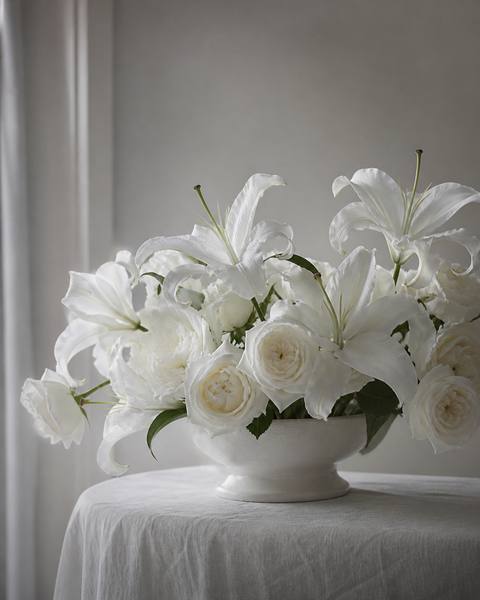
A larger, formal arrangement is appropriate. Spray of white lilies, white roses, white hydrangea, with green accents. Sent for the service, then a smaller follow-up sent to the home a few weeks later. The follow-up is often the one that means more, but the service arrangement is the one expected.
If you are very close to the family, also send a meal, a grocery delivery, or a stretch of "I will handle this thing for you for the next two weeks" practical help. The flowers are ceremonial. The meal and the practical help are the actual support.
Approximate cost: $100-$200 for the service arrangement. $40-$70 for the follow-up plant or smaller bouquet.
For an extended family member or friend of the deceased
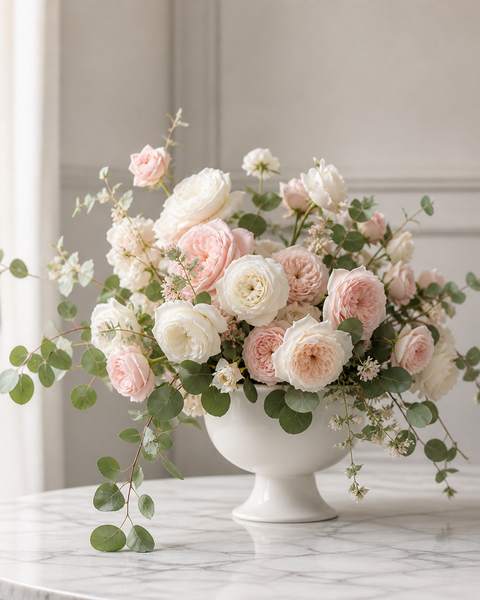
Mid-size arrangement, often softer in palette than the white-and-green standard. Cream, blush, soft yellow, lavender. Sent for the service or to the home, depending on which feels closer to the family.
Approximate cost: $65-$120.
For a coworker who lost a parent
This is the most common sympathy order for working adults. The default is a mid-size arrangement sent to the funeral home in the coworker's name (and sometimes from the team or department). White and cream tones. Card from the team.
A small but meaningful upgrade: also send a smaller arrangement directly to the coworker's home, signed personally. It separates your gesture from the office gesture. It costs you an extra $40 and lands much harder.
Approximate cost: $50-$80 for the team arrangement. Optional $40-$60 for the personal one.
For a friend who lost a pet
Pet loss is real loss. Many people are shy about acknowledging it because they worry the other person will think they are equating an animal to a human. They are not. The grief is its own kind, and it is not less.
A small arrangement, often paired with a handwritten card. Soft palette. Send within a week of the loss. The card matters more than the arrangement here. Mention the pet by name. Tell a small specific thing you remember about them.
Approximate cost: $40-$70.
For a friend who lost a child or had a stillbirth
This is the hardest sympathy order to place. The instinct is often to do nothing because you are afraid of doing the wrong thing. The wrong thing here is doing nothing. Send a small arrangement, often a flowering plant rather than cut flowers (longer-lasting, less ceremonial), with a note that says nothing more than "we are thinking of you" and the child's name.
Do not say anything that begins with "at least" or "everything happens for a reason" or "they are in a better place." The card is short, specific, and naming. For the hardest losses, the National Institute on Aging's guidance on supporting someone who is grieving is a steadying reference on what actually helps.
Approximate cost: $50-$90. Send in window one or window three. Skip window two unless the family has specifically asked for memorial arrangements.
What to write on the card
Most people freeze at the card. The blank space looks like it requires words people do not have.
The rule: short is correct. Two to four sentences. Specific to the person who died if you knew them. Honest about what you cannot say.
Useful templates, all of which I have seen land well:
- "I am so sorry. I will be thinking of your family. Please let me know if there is anything practical I can do."
- "We are heartbroken to hear about [name]. Holding you in our thoughts and sending love."
- "There are no good words. We are so sorry. Sending you all of our love during this hardest time."
- "I am thinking of you. I remember [one small specific thing about the deceased]. With deepest sympathy."
Templates to avoid:
- Anything starting with "at least"
- Anything that explains the death ("they had a long life", "they fought hard")
- Anything that sounds like a Hallmark stock phrase
- Anything religious if you do not know the family is religious
- Anything funny
Sign with your full name and a personal note about how you knew the deceased or the bereaved if it might not be obvious. The bereaved is reading dozens of these and may not place "From Sarah" without context.
The mistakes I watched people make
These are the patterns I watched go wrong over fifteen years on the receiving end of orders.
Sending the office arrangement only. The team-signed arrangement from the workplace is appropriate. Sending only that, when you are personally close to the bereaved, reads as if you only knew the deceased through work. If you knew them better, send a personal arrangement separately.
Sending too big. A six-foot floor spray to a small house arrives looking aggressive. The bereaved has to find space for it, water it, look at it for two weeks. The big arrangement is appropriate at the funeral home; it is wrong at the kitchen.
Sending dyed or unusually colored flowers. Bright blue roses, dyed carnations, anything that looks like it came from a discount supermarket. Sympathy arrangements should look like flowers, not like a craft project. Soft natural colors only.
Sending without a card. The card is the gift. The flowers are the messenger. A delivery arriving with no name on it forces the bereaved to guess. They will guess wrong.
Sending a religious arrangement to a family of a different religion. Crosses on Christian arrangements are common defaults. Skip these unless you know the family is Christian and observing. For Jewish families, do not send to the funeral home (it is uncommon in Jewish tradition) and instead send food or a donation. For Muslim families, simple white arrangements without religious imagery, sent to the home, are appropriate. When in doubt, ask a mutual friend.
Sending in window two only. The window-two arrangement at the funeral home is the obligation. The window-three arrangement weeks later is the gift. The people who sent only at the funeral did the obligated thing. The people who sent again two weeks later are the ones the bereaved remembered.
How to actually send
The order placement itself.
If the bereaved is local to you, an order with a local florist is the right call. They can build the arrangement to the family's specific situation, often coordinate timing with the funeral home directly, and ensure the placement is appropriate for the room or service.
If the bereaved is not local, a national flower delivery service is the practical choice. For sympathy specifically, Teleflora routes the order to a real local florist near the recipient (10,000-shop network in the US), which means the arrangement is built fresh and shaped properly for funeral or home placement. Their dedicated sympathy and funeral collection includes appropriate-sized arrangements with the right palette defaults. The competing services that ship from centralized warehouses are less suited for sympathy work because the arrangements are not built to be casket-side or memorial-table appropriate, and the timing is harder to coordinate with services.
The full comparison of all four major flower delivery services is in Best Flower Delivery Services Compared if you want to weigh other options.
A note on cost
Sympathy is one of the few moments where you should not optimize for the cheapest option. The recipient's grief deserves the slightly nicer arrangement. The math difference between the $50 and the $90 arrangement is not large compared to the meaning of the gesture. Spend the slightly-more.
The exception: very tight personal budgets. If you are choosing between sending nothing or sending the cheap arrangement, send the cheap arrangement. The arrival of any arrangement is more meaningful than any specific quality of flowers.
What I tell people who ask me
If somebody calls me with a "what should I send" question for a sympathy occasion, the answer I default to is this: a mid-size arrangement, white and cream tones, sent to either the home or the funeral home depending on closeness, with a short specific card naming the deceased. Cost around $80. Add a window-three follow-up plant or small arrangement if you are close.
That is the default. Almost every sympathy order I would recommend is some variation of that.
The flowers do not fix anything. They are not supposed to. What they do is mark, on the day, that you noticed. The mark matters. People remember who marked.
Frequently Asked Questions
Should you send sympathy flowers to the home or the funeral home?
Sympathy flowers are best sent to the family's home, where they comfort the bereaved through the hardest days of phone calls, visitors, and quiet. Smaller, softer arrangements that live in the kitchen or living room are the right format. Larger formal arrangements designed for casket-side placement belong at the service instead. If you are close to the bereaved, the home is almost always the better destination.
When is the best time to send sympathy flowers?
There are three windows. Within a day or two of the death (sent to the home), timed to the service itself, or one to four weeks after the funeral. The third window is the most underused and the most remembered, because it arrives after the crowd has left and the bereaved is alone in the quiet. If you want your gesture to land hardest, send something a few weeks out.
What should you write on a sympathy card?
Keep it to two to four sentences, specific to the person who died if you knew them, and honest about what you cannot say. Name the deceased and one small true thing about them. Sign with your full name and a note on how you knew them, since the bereaved is reading dozens of cards. Avoid anything that starts with "at least," anything that explains the death, and anything that sounds like a stock greeting-card phrase.
Is it appropriate to send sympathy flowers for the loss of a pet?
Yes. Pet loss is real loss and the grief is its own kind. A small arrangement in a soft palette, paired with a handwritten card that names the pet and remembers one specific thing about them, is appropriate. Send it within a week of the loss. The card matters more than the flowers here.
What should you avoid when sending sympathy flowers to the home?
Avoid arrangements that are too large for a small house, dyed or unnaturally colored flowers, and anything without a card, which forces the bereaved to guess who sent it. Skip religious imagery like crosses unless you know the family observes that faith. For a family of a different tradition, a simple white arrangement with no religious motif is the safe choice.
Further reading
For the strict-sequence rules around funeral arrangements specifically (size, type, casket-side appropriateness), see Funeral Flower Etiquette: The Rules Nobody Tells You. For an overview of all flower-delivery services, see Best Flower Delivery Services Compared.
The American Hospice Foundation publishes accessible guides on grief support that pair well with the sympathy gesture.